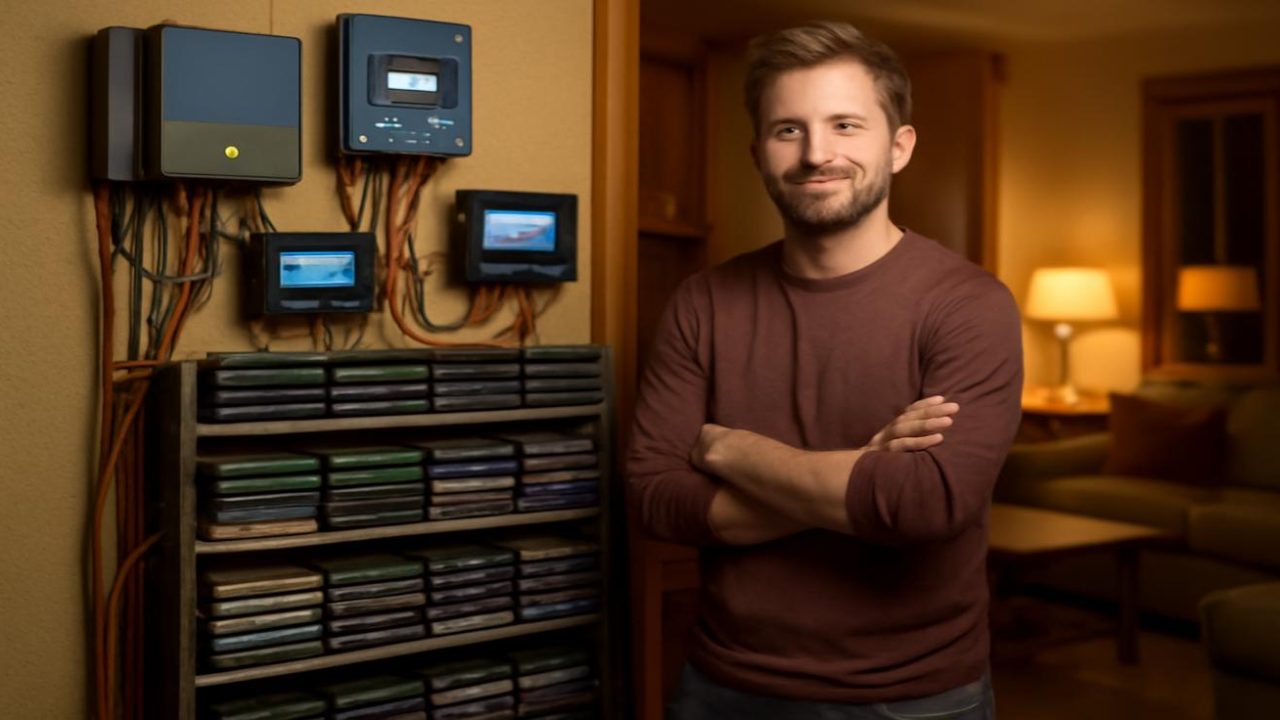
More than 650 discarded laptop batteries now power an entire suburban home — and they were all rescued from the trash. For the past decade, one determined engineer has been proving that electronic waste isn’t always waste at all.
What started as curiosity about a dead laptop has evolved into a remarkable home energy system. Daniel discovered that when laptop battery packs fail, most of the individual cells inside are still perfectly functional. Those finger-sized 18650 rechargeable cylinders that power laptops, e-bikes, and power tools often retain 60-70% of their original capacity even when the pack itself stops working.
The result is a garage that looks like something between a mad scientist’s lab and an art installation — walls lined with colorful battery cylinders in green, purple, blue, and pink, all hand-soldered into neat packs with blinking LEDs and a soft electrical hum filling the air.

How Dead Laptops Became a Power Source
Daniel’s journey began with a simple refusal to throw away a laptop that wouldn’t hold a charge. Instead of tossing the dead battery pack, he cracked it open to see what was inside. What he found changed everything.
The pack contained six small cylindrical cells that looked perfectly normal — no swelling or obvious damage. Testing them with a basic multimeter revealed that four of the six still held most of their capacity. The pack was junk, but the individual cells weren’t.
That discovery sparked a question that would define the next ten years of his life: if one old laptop had four good cells, how many perfectly functional batteries were being thrown away every year?

The answer, as it turns out, is thousands. Laptops age and their batteries wear out from the perspective of someone wanting hours of portable power. But for storing solar energy overnight, a cell with 60% of its original capacity isn’t garbage — it’s potential.
Building a Battery Collection Network
Daniel began systematically collecting discarded laptop batteries from every source he could find. He asked friends, coworkers, and local repair shops to save their dead battery packs instead of throwing them away.
At first, people looked at him strangely. But gradually, the trickle of donations became a steady stream. A friend’s office upgraded their laptops and delivered a box of old batteries to his porch. The local electronics recycler let him sort through their “hazard bin” in exchange for help moving old equipment.

The process of testing and sorting became a nightly ritual. After work, Daniel would change into old clothes and disappear into his garage to crack open the brittle plastic battery cases. Each individual cell got numbered with a permanent marker, then cycled through a basic charger-tester to measure its capacity and performance.
Any weak, damaged, or suspicious cells were set aside for proper recycling. The survivors — cells that still held substantial charge — were destined for something bigger.
The Technical Challenge of Laptop Battery Recycling
Converting hundreds of individual laptop battery cells into a home power system requires meticulous attention to detail. Daniel describes the testing process as “meditative” — like “shelling peas, but for nerds.”

Each cell must be individually tested for voltage, capacity, and internal resistance. The data gets recorded in spreadsheets that have grown into a comprehensive biography of his battery collection over the years. Only cells that meet strict performance criteria make it into the final power bank.
The physical construction involves hand-soldering the approved cells into organized packs, complete with monitoring systems and safety circuits. The finished installation looks like a colorful stained-glass window designed by an engineer, with rows of batteries stacked in precise formations.
| Battery Source | Typical Cell Count | Average Usable Cells |
|---|---|---|
| Standard Laptop | 6 cells | 4 cells |
| High-Capacity Laptop | 9 cells | 6 cells |
| Gaming Laptop | 8-12 cells | 6-8 cells |
Real-World Performance of a Recycled Battery System
The system Daniel has built powers his entire home using solar panels during the day and stored battery power at night. The setup keeps lights on, the refrigerator running, and computers operational even when the electrical grid goes down.

The garage installation creates an almost musical atmosphere with its soft humming and blinking LED indicators. Tiny lights pulse and shift in the dimness, casting moving patterns across tools and shelves. The smell of warm plastic, solder, and sawdust fills the air.
Outside, solar panels on the roof quietly collect sunlight during the day. Inside, the recycled battery bank stores that energy for use after dark. The entire system runs on components that would otherwise have ended up in landfills.
What makes this approach particularly compelling is the performance gap between laptop requirements and home storage needs. A battery that can’t power a laptop for four hours might be considered “dead” for portable use, but still perfectly adequate for overnight home power storage.

The Environmental Impact of Battery Waste
Daniel’s project highlights a significant environmental issue with electronic waste. Millions of laptops are discarded or recycled every year, most with battery packs that contain multiple functional cells.
Traditional recycling processes often don’t distinguish between completely dead batteries and packs with partially functional cells. The entire assembly typically gets processed as hazardous waste, even when individual components retain substantial utility.
By rescuing and repurposing these cells, Daniel has prevented hundreds of functional batteries from entering the waste stream. His collection of more than 650 cells represents components that would have been processed as hazardous waste despite retaining 60-70% of their original capacity.

The project demonstrates that with patience and technical knowledge, significant amounts of electronic waste can be transformed into useful energy storage systems. The key is recognizing that component failure doesn’t necessarily mean every part is worthless.
Frequently Asked Questions
Is it safe to disassemble old laptop batteries at home?
The source doesn’t provide specific safety guidelines, but Daniel emphasizes careful testing and proper disposal of damaged cells.
How long does it take to test each individual battery cell?
The article describes the process as slow and meticulous, involving charge-discharge cycles and capacity measurements, but doesn’t specify exact timeframes.

What percentage of laptop battery cells are typically still functional?
Based on Daniel’s initial discovery, approximately 4 out of 6 cells (about 67%) in a failed laptop battery pack may still retain substantial capacity.
How much money can this approach save on electricity bills?
The source doesn’t provide specific cost savings data, focusing instead on the technical and environmental aspects of the project.
What tools are needed to build a similar system?
Daniel mentions using a basic multimeter, charger-tester, soldering equipment, and permanent markers, though complete equipment lists aren’t provided.
How does the power company feel about home battery systems?
The article suggests power companies “would probably rather you didn’t ask too many questions” about such setups, but doesn’t elaborate on specific policies or reactions.











Leave a Comment