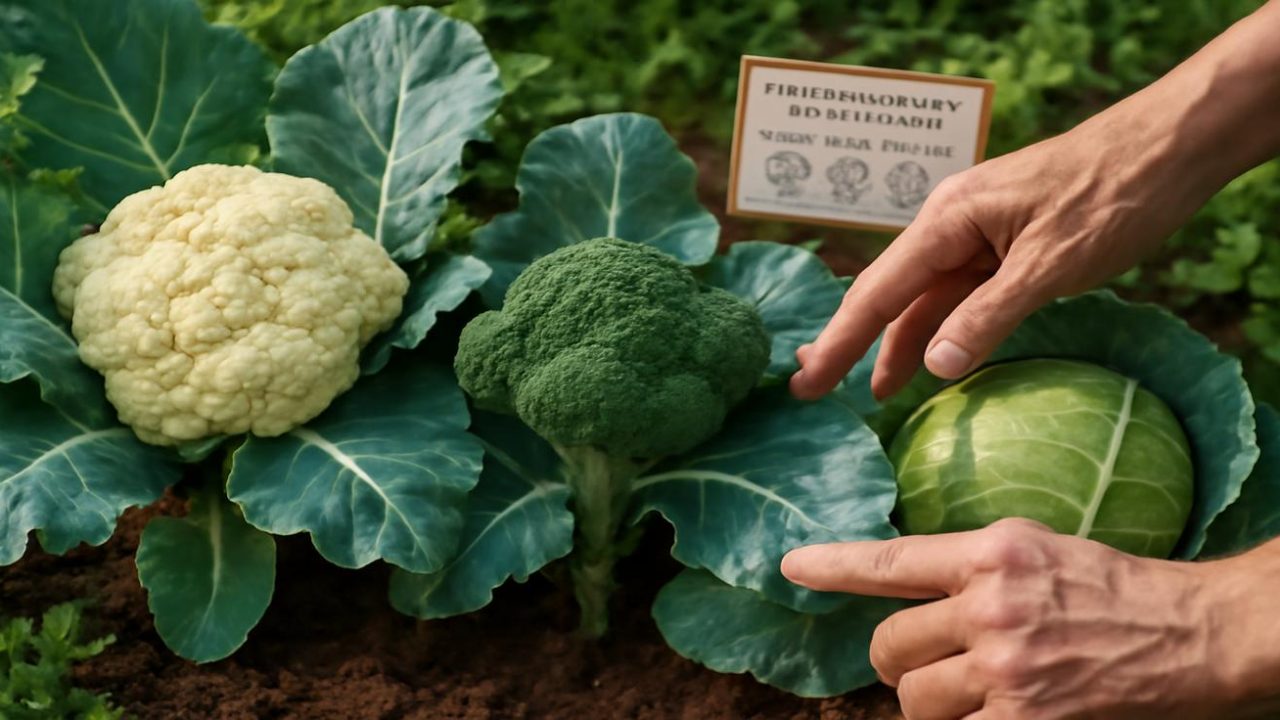
Cauliflower, broccoli, and cabbage may look like completely different vegetables in your grocery cart, but they share an extraordinary secret: they’re all the exact same plant species. These seemingly distinct vegetables are actually variations of a single wild ancestor that humans have been selectively breeding for thousands of years.
Their shared scientific name is Brassica oleracea, and understanding this botanical relationship changes how you see these common kitchen staples forever.
What appears to be three separate vegetables is really one remarkably adaptable plant that has been shaped into wildly different forms through careful cultivation across generations.

How One Wild Plant Became Three Kitchen Staples
The story begins with a tough, scrubby plant clinging to European sea cliffs thousands of years ago. This wild ancestor bore little resemblance to today’s neat grocery store vegetables. It was a survivor with thick, waxy leaves designed to withstand salt spray, thin soil, and harsh coastal conditions.
Early foragers discovered this resilient plant provided valuable nutrition, especially when other greens weren’t available. Over time, they noticed natural variations among individual plants—some had thicker leaves, others had plumper stems, and some developed more compact flower clusters.
Ancient farmers began the slow process of selective breeding, saving seeds only from plants with their preferred traits. They didn’t understand genetics, but they were directing evolution with every planting decision.

In different regions, people favored different characteristics. Some communities prized plants with large, sweet leaves. Others preferred swollen flower buds. Still others valued thick, fleshy stems. Each preference gradually created distinct varieties from the same genetic foundation.
The Science Behind the Transformation
Think of Brassica oleracea as a basic plant template with roots, stems, leaves, buds, and flowers. Each familiar vegetable represents an extreme development of one particular plant part.
Cabbage maximizes leaf development. The plant folds its leaves tightly into a dense, protective ball that stores energy and nutrients. That familiar round head is essentially a cluster of modified leaves wrapped around each other.

Broccoli focuses on flower bud production. The plant concentrates enormous numbers of immature flower buds into branching clusters. What you eat are thousands of tiny flower buds that never fully opened.
Cauliflower takes flower development even further. Its flower structures swell and fuse together into a solid, creamy mass. The entire “head” consists of modified flower parts that have grown abnormally large and dense.
The thick broccoli stalk that many people discard is essentially a reimagined cabbage stem. Cauliflower’s spiral patterns are swollen flower buds frozen in development. Cabbage’s layered heart represents leaves folding inward on themselves.

Comparing the Brassica oleracea Varieties
Understanding these vegetables becomes clearer when you examine their shared characteristics and key differences side by side.
| Vegetable | Primary Feature | What You’re Eating | Growing Pattern |
|---|---|---|---|
| Cabbage | Dense leaf cluster | Tightly packed leaves | Leaves fold inward |
| Broccoli | Branching flower buds | Immature flowers | Buds cluster on stems |
| Cauliflower | Fused flower mass | Modified flower parts | Flowers merge into solid head |
All three vegetables share the same basic nutritional profile because they’re genetically identical. They’re all excellent sources of vitamin C, fiber, and various antioxidants. The main differences lie in texture, flavor intensity, and specific nutrient concentrations.
Brussels sprouts, kale, and kohlrabi are also members of this same species, representing additional variations on the Brassica oleracea theme. Each emphasizes different plant structures—Brussels sprouts develop tiny cabbage-like buds along the stem, while kale maintains the loose leaf structure closer to the original wild form.

What This Means for Your Kitchen
Recognizing these vegetables as botanical siblings explains why they often work interchangeably in recipes. Their similar cellular structure means they respond to cooking methods in comparable ways.
You can substitute cauliflower for broccoli in most dishes with only minor adjustments to cooking time. Cabbage stems have a similar texture to broccoli stalks and can be prepared using identical techniques.
This relationship also explains why these vegetables share certain flavors, particularly when raw. They all contain similar sulfur compounds that create their characteristic sharp, slightly bitter taste. Cooking mellows these compounds in predictable ways across all varieties.

Understanding their shared genetics helps explain storage and preparation similarities. All three vegetables prefer cool, humid storage conditions and benefit from similar washing and trimming techniques.
The Ongoing Evolution
Plant breeders continue developing new variations of Brassica oleracea today. Purple cauliflower, orange cauliflower, and romanesco—with its striking fractal patterns—represent recent additions to this ancient family tree.
Modern breeding techniques allow for much faster development of new varieties, but the basic process remains the same as those early coastal farmers employed. Breeders still select for desired traits and cross-pollinate plants to enhance specific characteristics.

Some newer varieties combine features from different traditional forms. Broccoflower merges broccoli and cauliflower traits, while certain cabbage varieties develop looser heads that resemble oversized Brussels sprouts.
Climate change is driving development of more heat-tolerant and disease-resistant varieties, ensuring these vegetables remain viable crops as growing conditions shift worldwide.
Frequently Asked Questions
Are cauliflower, broccoli, and cabbage really the same plant?
Yes, they’re all varieties of Brassica oleracea, selectively bred to emphasize different plant parts over thousands of years.

Can these vegetables cross-pollinate with each other?
Since they’re the same species, they can cross-pollinate and produce viable offspring with mixed characteristics.
Why do they look so different if they’re genetically identical?
Selective breeding has emphasized different plant structures—leaves in cabbage, flower buds in broccoli, and modified flowers in cauliflower.
What did the original wild plant look like?
The wild ancestor was a tough coastal plant with thick, waxy leaves and small flower clusters, resembling modern wild kale more than any grocery store vegetable.
Are there other vegetables in this same family?
Yes, Brussels sprouts, kale, kohlrabi, and collard greens are also varieties of Brassica oleracea.
Do they have the same nutritional value?
They share similar basic nutrition profiles since they’re the same species, though specific vitamin and mineral concentrations may vary slightly between varieties.










Leave a Comment